In 2026, hotel gyms are becoming practical extensions of the guest experience. Travelers expect clean, flexible, and intuitive training spaces. They may exercise before a meeting, after a long flight, or between sightseeing plans. Therefore, global buyers need equipment that supports different ages, abilities, and fitness habits.
Ray Algar, founder of Oxygen Consulting and a respected fitness-industry analyst, has said, “The fitness industry is a people business.” This principle matters when selecting Hotel Gym Fitness Equipment. A premium treadmill is useful, but it cannot replace thoughtful planning. Buyers should examine cardio machines, selectorized strength equipment, functional trainers, free weights, mobility tools, and recovery products. Each category serves a different guest need. Quiet motors matter in rooms near bedrooms. Compact racks matter in small urban hotels. Durable upholstery matters when usage remains unpredictable.
The strongest equipment mix is not always the most expensive one. It should match hotel size, guest profile, maintenance capacity, and available floor space. Some buyers may overvalue screens and connected features. Guests might simply need reliable resistance and a safe walking surface. That assumption deserves review. Technology can improve engagement, but it also creates service and replacement demands. A broken display can make an impressive machine feel unusable.
This guide examines the leading Hotel Gym Fitness Equipment types for global buyers in 2026. It considers usability, durability, accessibility, cleaning practicality, energy consumption, and long-term value. Regional expectations also differ. A resort gym may prioritize functional training and recovery zones. A business hotel may need compact cardio equipment and efficient strength stations. The right choice is rarely universal. It is usually more specific, and sometimes less glamorous, than buyers expect.
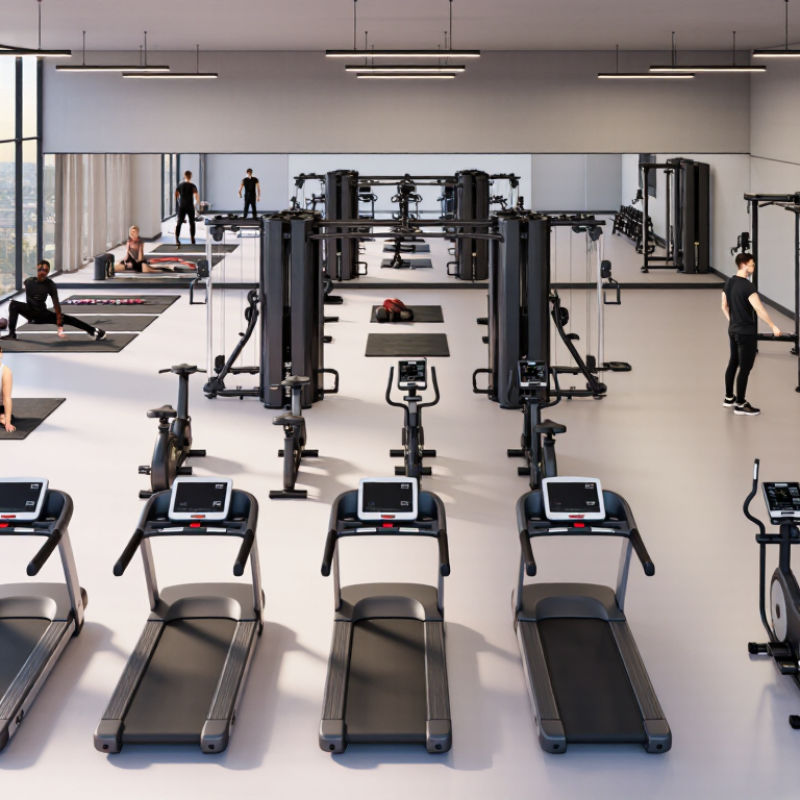
2026 Top Hotel Gym Fitness Equipment Types for Global Buyers
Hotel Gym Fitness Equipment Market Overview for Global Buyers
The hotel fitness equipment market is becoming more practical and space-conscious. Global buyers now seek reliable equipment for different guest profiles, not oversized gym floors. Cardio machines remain essential, especially treadmills, upright bikes, and elliptical trainers. Strength areas commonly include adjustable benches, cable stations, dumbbell racks, and compact resistance machines. Functional training tools are also gaining attention. Kettlebells, medicine balls, mats, and suspension systems require little space.
Procurement decisions depend on hotel location, room size, guest volume, and operating budget. A city hotel may need quiet, compact machines for a small 30-square-meter gym. A resort can support heavier equipment and wider training zones. Noise control matters near guest rooms. Easy-to-clean surfaces matter everywhere. Buyers should check voltage requirements, warranty coverage, replacement parts, and local service response before ordering. These details often affect long-term value more than the initial price.
Durability should be tested through repeated use, not only product documents. A treadmill can look impressive but perform poorly under constant guest turnover. That mistake still happens. Safety instructions, user access, maintenance records, and installation quality deserve equal attention. Digital consoles may improve engagement, yet complicated systems can frustrate occasional users. Market forecasts are useful, but they are never perfect. Hotel owners should compare sales data, guest feedback, and maintenance history before expanding equipment categories.arsuarmi
| Equipment Type | Main Hotel-Gym Application | Typical Commercial Specifications | Approx. Footprint per Unit | Power and Installation Notes | Key Global-Buyer Considerations |
|---|---|---|---|---|---|
| Commercial Treadmill | Primary cardio equipment for general hotel guests, business travelers, and endurance users. | Running surface commonly about 51–56 cm wide and 140–155 cm long; maximum speed commonly 16–22 km/h; motor output and user-weight capacity vary by commercial class. | Approximately 0.8–1.3 m², excluding recommended clearance. | Usually requires a dedicated electrical circuit. Confirm voltage, frequency, plug type, circuit protection, ventilation, noise, and floor loading before ordering. | High guest recognition and utilization potential; prioritize shock absorption, low noise, emergency-stop features, service access, and local electrical compliance. |
| Elliptical Cross-Trainer | Low-impact cardiovascular training with both lower- and upper-body movement. | Stride length commonly around 45–53 cm; multiple resistance levels; moving handlebars; commercial consoles may include time, speed, distance, calories, and heart-rate data. | Approximately 0.7–1.1 m². | Self-powered models can simplify installation; powered consoles may require electrical or USB connectivity. Allow front, rear, and side access for safe movement. | Useful for mixed-age users and rehabilitation-oriented exercise; assess step-up height, handle ergonomics, stability, and accessibility. |
| Upright Exercise Bike | Compact cardio option for short workouts and space-efficient hotel fitness rooms. | Adjustable saddle; electronic or mechanical resistance; common displays show cadence, speed, time, distance, calories, and heart rate. | Approximately 0.45–0.75 m². | Many commercial units are self-powered or use low-voltage console power. Provide a level, non-slip surface and sufficient rear clearance. | Strong choice where floor area is limited; verify saddle adjustment range, pedal security, corrosion resistance, and ease of cleaning. |
| Recumbent Exercise Bike | Seated low-impact training for older adults, beginners, and guests requiring additional back support. | Back-supported seat with horizontal adjustment; step-through access; adjustable resistance and basic performance monitoring. | Approximately 0.8–1.2 m². | Usually simple to install; ensure clear access around the front and sides and use flooring that supports stable entry and exit. | Supports inclusive hotel-gym design; examine seat comfort, adjustment mechanism, ingress height, and cleaning access. |
| Indoor Rowing Machine | Full-body cardiovascular and muscular-endurance training with a relatively small storage footprint when stored vertically. | Long rail commonly about 2.0–2.5 m; air, magnetic, water, or hybrid resistance; adjustable footrests and performance monitor. | Approximately 0.7–1.0 m² in use; vertical storage area varies by model. | Generally low installation complexity. Maintain adequate rear clearance and inspect chain, rail, foot straps, and resistance system regularly. | Attractive for performance-oriented guests; prioritize smooth resistance, low operating noise, secure footplates, and safe storage procedures. |
| Selectorized Strength Machine | Guided resistance training for major muscle groups with straightforward guest operation. | Weight-stack resistance commonly 50–120 kg depending on exercise; adjustable seat or pad positions; enclosed or guarded moving components. | Approximately 1.0–1.8 m² per station. | No electrical connection normally required. Confirm floor anchoring requirements, ceiling height, access route, and adequate clearance around moving arms. | Suitable for unsupervised hotel use; prioritize pictorial instructions, accessible adjustments, cable protection, durable upholstery, and anti-pinch design. |
| Functional Trainer and Cable Crossover | Versatile training including presses, pulls, rotational exercises, rehabilitation movements, and small-group workouts. | Dual adjustable pulleys; multiple cable height positions; common weight stacks of approximately 50–100 kg per side; optional pull-up station. | Approximately 2.5–5.0 m², depending on configuration. | May require floor anchoring and sufficient ceiling height, commonly around 2.4–2.8 m. Confirm structural requirements and user circulation space. | High exercise versatility per square metre; inspect cable routing, pulley smoothness, attachment storage, frame stability, and user-flow safety. |
| Free-Weight Area | Strength training using dumbbells, barbells, benches, racks, and weight plates. | Dumbbell sets commonly range from light introductory weights to 30 kg or more; commercial benches and racks should match the intended load and usage level. | Allow approximately 2.5–4.0 m² per active training position, including user and equipment clearance. | Use impact-resistant flooring and verify concentrated floor loads, rack anchoring, storage capacity, ventilation, and noise control. | Requires clear safety signage and organized storage; select corrosion-resistant finishes and benches with stable adjustment systems. |
| Multi-Station Gym | Several guided resistance exercises in one integrated frame for compact hotel fitness rooms. | Common configurations provide 3–8 exercise stations, shared or independent weight stacks, and fixed movement paths. | Approximately 4–10 m², depending on station count and layout. | Usually non-powered; may require anchoring and careful delivery planning because of frame size and assembled weight. | Efficient where equipment variety is needed in limited space; compare maintenance access, simultaneous-use capacity, and replacement-part availability. |
| Functional Accessories and Mobility Equipment | Warm-up, stretching, balance, mobility, bodyweight exercise, and light functional training. | Typical items include exercise mats, resistance bands, medicine balls, kettlebells, suspension straps, foam rollers, steps, and balance tools. | Storage footprint commonly 0.5–2.0 m²; active-use area depends on exercise type. | No power required. Use wall or rack storage to reduce trip hazards and keep walkways clear. | Low procurement cost with broad usability; prioritize washable materials, tear resistance, non-slip surfaces, and simple inventory control. |
| Connected Fitness Console and Monitoring Features | Provides workout feedback, equipment controls, entertainment, and optional integration with digital guest services. | Common functions include time, speed, distance, calories, resistance, heart-rate compatibility, USB charging, and wireless connectivity. | Integrated into equipment; dedicated screen or tablet mounts may add approximately 0.1–0.3 m². | Confirm Wi-Fi coverage, data privacy responsibilities, software-update process, electrical compatibility, and whether subscriptions are required. | Evaluate multilingual interfaces, offline operation, cybersecurity, guest-data handling, warranty coverage, and long-term software support. |
Treadmills support short, familiar workouts for business travelers. Upright bikes save floor space. Ellipticals offer joint-friendly movement. A balanced room usually needs several types, not one crowded machine group.
Recumbent bikes provide extra back support and easier seating. They may suit older guests or users with limited mobility. Place one near an accessible path.
Rowers train many muscle groups, but they need clear technique guidance. Some guests may avoid them. A smaller property should test demand before adding several units.
Keep treadmills away from sleeping rooms when vibration control is weak. Place bikes near windows when possible. Leave clear walkways around every machine. Small layouts need flexibility.
Displays should show time, distance, heart rate, and energy use clearly. Multilingual instructions can reduce confusion. Offline operation still matters when network service fails.
Look for welded frames, stable footplates, quiet motors, sealed bearings, and corrosion-resistant finishes. Coastal air can damage weak coatings. Rust around bolts is a warning.
Request service manuals, installation training, spare parts, and local technical contacts. Confirm response times in writing. Test support before signing a large contract.
Follow guest behavior instead of showroom appearance. Two busy treadmills may outperform an unused rowing area. Usage data helps, but local habits deserve the final decision. That judgment can still be imperfect.
Confirm electrical requirements, software compatibility, safety documentation, warranty terms, and offline functions. Request real workout demonstrations, not only showroom startups. Ask similar hotels about service performance.
This guide examines the 2026 Hotel Gym Fitness Equipment market from the perspective of global buyers, focusing on how hotels can create practical, attractive, and reliable fitness spaces. It explains the main cardio equipment categories, such as treadmills, bikes, ellipticals, and rowers, and shows how each can support different hotel layouts, guest profiles, and workout preferences. It also covers strength and functional training options, including adjustable resistance systems, free weights, benches, cable stations, and multi-purpose equipment for both beginners and experienced users.
The article further explores space planning, circulation, flooring, ventilation, safety procedures, and accessibility considerations to help hotels design comfortable and inclusive gyms. Finally, it outlines key purchasing criteria, including equipment durability, user-friendly technology, energy efficiency, cleaning requirements, maintenance planning, warranty coverage, spare-parts availability, installation, and supplier support. These factors can help international hotel buyers control long-term costs while delivering a consistent and positive guest experience.