Choosing a Commercial Fitness Equipment Exporter is not simply a matter of comparing prices. The supplier affects product quality, delivery reliability, installation planning, and after-sales support. A polished catalog can look convincing. It proves very little on its own.
Start with the equipment your facility actually needs. A hotel gym may require compact treadmills and quiet strength machines, while a training studio may prioritize durability and frequent use. Ask for clear specifications, warranty terms, spare-parts availability, and realistic production timelines. Request product photos and videos that show details such as welds, cable routing, console controls, and protective finishes. Small details matter.
Then examine how the exporter manages quality and communication. Ask whether it can provide inspection records, product test information, and references from comparable projects. Confirm which services are included, such as packaging, shipping coordination, installation guidance, or remote troubleshooting. Get responsibilities and costs in writing. Clarity helps.
A reliable exporter should answer specific questions without rushing you toward a deposit. Compare responses, not just quotations. If a timeline seems unusually short, ask how it will be met. If specifications remain vague, pause. Even experienced buyers can overlook a practical issue, such as replacement parts taking weeks to arrive. This guide explores the checks that help buyers assess exporters more carefully, reduce avoidable surprises, and choose a supplier suited to their facility. No checklist removes every risk, but better questions make the decision more grounded.
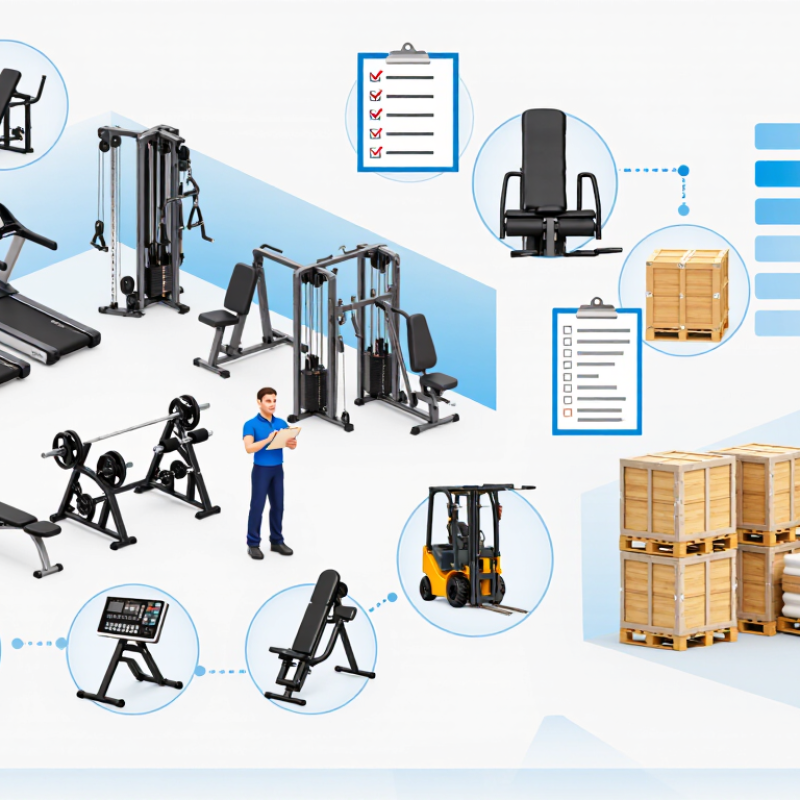
Before comparing commercial fitness equipment exporters, write down what the facility must do each day. List equipment categories, quantities, and peak-hour users, not just a preferred machine count. Start with the room. Measure usable floor area, ceiling height, door openings, and elevator capacity. Mark columns, power outlets, ventilation points, and clear routes on a simple plan. A floor plan can look generous on screen; a tape measure often disagrees.
Define who will use each station and how often. New members may need simple adjustments, while coached athletes may expect finer load increments. Record expected daily cycles, user weight ranges, and accessibility needs. These details affect frame strength, adjustment design, spacing, and maintenance intervals. Be specific. “Heavy use” is vague; a realistic hourly estimate is more useful. Note whether equipment must arrive assembled, fit through narrow corridors, or be installed in phases.
Set practical performance requirements before requesting quotations: dimensions, resistance type, display functions, noise limits, and service access. Decide which records you need, such as manuals, spare-parts lists, and warranty terms. Confirm that proposed specifications and documentation suit the destination market and your facility’s operating needs. Include maintenance capacity and replacement-part lead times in the plan, not as afterthoughts. Budgets can be awkward. Still, separate purchase cost from delivery, installation, upkeep, and likely downtime. Some assumptions will change after a site visit. Leave room to revise quantities rather than forcing a neat, unrealistic list.
A commercial fitness equipment exporter should be able to prove who it is and how it handles orders. Request its business registration, export references, factory address, and the scope of any ISO 9001 certificate. Check that the certificate covers the relevant manufacturing or quality processes, not merely an unrelated office. The Health & Fitness Association’s 2024 Global Report counted about 184 million members across 65,000 fitness facilities in 19 countries. That scale makes reliable production, documentation, and after-sales support practical concerns—not minor details. A large shipment record is useful, but ask whether it involved equipment similar to yours.
Ask for recent customer references, sample inspection reports, and a clear account of how defects are handled. Compare the exporter’s stated lead times with dated production records, packing lists, and shipment documents. Where possible, arrange an independent factory audit or pre-shipment inspection. Look closely at welds, cable routing, adjustment points, and protective packaging; these details can reveal more than a polished catalogue. Verify that spare parts and manuals can be supplied for the models you plan to buy. I would not rely on a brochure alone. Still, a certificate is not a guarantee, and even a careful review can miss problems. That deserves a second look.
These are typical benchmarks for accredited management-system certification: surveillance audits are generally conducted at least annually, with recertification commonly on a three-year cycle. Requirements can vary by certification scheme, so verify the certificate and its status with the issuing certification body. Also ask for dated export references, shipment records, and experience with the specific fitness equipment categories you plan to source.
Assess product quality on the equipment itself, not only polished catalog photos. Ask for close-ups of welds, upholstery seams, adjustment pins, and cable connections. Request load ratings and test records for the exact models you plan to order. If possible, inspect a sample under normal use. A loose bolt or rough seat edge can reveal more than a brochure. I would not treat a neat finish as proof of durability; that is an easy mistake.
Customization should be specific and documented. Discuss frame colors, upholstery, logo placement, voltage requirements, packaging, and user instructions before production. Ask for drawings or a sample showing the changes. Confirm minimum order quantities, production time, spare-part availability, and how defects are handled. Vague promises are not enough. One imperfect point: custom changes can extend lead times, even when they seem minor. Get the revised schedule in writing, and check that the final specification matches the quotation before approving the order.
How to Choose a Commercial Fitness Equipment Exporter
Compare quotes line by line, not just by the equipment’s listed price. Ask whether the offer includes packaging, accessories, spare parts, and delivery to your facility. Clarify the payment schedule and what could change the final cost. A low quote can be tempting. It may also leave important details unstated. Request an itemized estimate, then compare equivalent equipment and service levels.
Shipping deserves the same scrutiny. Ask for the estimated production time, transit window, and shipment terms in writing. Confirm who arranges freight, handles unloading, and provides tracking updates. For heavy equipment, check how machines are secured inside crates and whether dimensions suit your receiving area. Request recent packaging photos if available. Delays still happen, so ask how the exporter communicates schedule changes and reports damage. No estimate is exact.
Communication can reveal how workable a supplier will be after an order is placed. Send a few specific questions about specifications, replacement parts, and delivery dates. Note whether answers are clear, consistent, and supported by documents. A quick reply is useful, but accuracy matters more. Keep written records of agreed details, even when the conversation feels straightforward. It is easy to assume everyone means the same thing. Often, they do not.
| Comparison Dimension | What to Compare in Each Quote | Strong, Verifiable Practice | Questions and Warning Signs |
|---|---|---|---|
| Product specification | Model, dimensions, materials, rated capacity, electrical requirements, included accessories, and agreed customization. | The quotation and product documents identify the same specifications, options, and quantities. | Are model details missing, or are substitutions allowed without written approval? |
| Quoted price | Unit price, quantity, currency, discounts, tooling or customization charges, and the quote’s validity period. | Each charge is itemized, and the supplier states what is included and excluded. | Are installation, packaging, spare parts, or other charges unclear or added only after the order? |
| Total landed cost | Product price plus freight, insurance, duties, taxes, customs clearance, and destination handling where applicable. | Offers are compared using the same destination, shipment size, delivery scope, and assumptions. | Does the comparison omit import duties, local charges, or final delivery costs? |
| Incoterms and handover | The named Incoterms® rule, version, and precise named place or port—for example, FOB at a specified port or DAP at a specified address. | The buyer and exporter clearly understand who arranges transport, insurance, export clearance, and import clearance. | Is the term shown without a named place, or is responsibility for import clearance ambiguous? |
| Shipping plan | Transport mode, estimated transit time, routing assumptions, shipment-ready date, and whether delivery is port-to-port or door-to-door. | The exporter distinguishes production lead time from transit time and identifies the basis of the estimate. | Is a delivery date promised without explaining production, booking, or customs assumptions? |
| Packing and loading | Package dimensions and weights, packing materials, container or pallet plan, and protection for heavy or fragile components. | Packing information is available for freight planning and matches the ordered equipment. | Can the exporter provide packing details before shipment booking? |
| Payment terms | Deposit and balance amounts, payment milestones, accepted methods, and any applicable banking fees. | Payment milestones, beneficiary details, and order conditions are documented in the contract or invoice. | Are payment instructions inconsistent, or are changes to bank details communicated without independent verification? |
| Production and inspection | Production schedule, inspection stages, acceptance criteria, and responsibility for inspection costs. | The parties agree in writing how product conformity will be checked before dispatch. | Is inspection access restricted, or are acceptance criteria left undefined? |
| Warranty and spare parts | Warranty duration and coverage, exclusions, claim process, replacement-part availability, and shipping responsibility for parts. | Coverage and claim steps are written clearly, with the relevant parts and service process identified. | Does the warranty exclude key components without making those exclusions clear? |
| Communication practices | Primary contact, backup contact, working hours and time zone, update frequency, and response process for urgent issues. | One accountable contact provides written updates and confirms decisions, changes, and shipment milestones. | Are answers delayed, contradictory, or not recorded in writing? |
| Documents and compliance | Commercial invoice, packing list, transport document, certificates or test reports required for the destination market, and product manuals. | Required documents are identified early and checked against the destination country’s applicable rules. | Are documents unavailable, inconsistent with the goods, or presented as universally valid for every market? |
| Order changes and problem resolution | Process for changes, delays, damaged goods, shortages, claims, and agreed remedies. | Responsibilities, notification steps, and supporting evidence requirements are recorded before shipment. | Does the exporter avoid defining how discrepancies or shipping damage will be handled? |
Comparison tip: Request the same specifications, quantities, destination, and delivery scope from every exporter. Freight costs, transit times, duties, and compliance requirements vary by route, shipment, and market; verify them against current written quotes and destination-country rules.
A commercial fitness equipment warranty is useful only when its boundaries are clear. Ask for the full written terms before comparing quotes. Check coverage periods for frames, motors, electronics, and upholstery separately. These parts age differently. Confirm whether labor, replacement parts, and shipping are included, and who pays return freight when a component fails.
Do not rely on phrases such as “global support.” Ask who handles service in your destination market and whether technicians can diagnose faults remotely. Request typical response times, spare-parts dispatch estimates, and the process for reporting a problem. Get it in writing. A clear contact route matters when a treadmill is down during peak hours.
Review exclusions carefully, especially for wear items, poor installation, or missed maintenance. Ask whether the exporter provides setup instructions, maintenance schedules, and access to common replacement parts. Keep serial numbers, delivery records, and service messages together; these can speed up a warranty claim. It is easy to focus on the equipment price and skim the fine print. That is a mistake worth reconsidering: vague support terms can mean longer downtime and unexpected costs.
Request close-up photos of welds, upholstery seams, adjustment pins, and cable connections. A rough seat edge matters.
No. Ask for model-specific load ratings and test records. If possible, inspect a sample during normal use.
Confirm each certificate names the exact product and model, remains current, and identifies the testing body. Keep copies.
Document colors, upholstery, logo placement, voltage, packaging, and user instructions. Request drawings or a sample. Small changes can delay production.
Confirm minimum order quantities, production time, spare-part availability, and defect handling. Get the revised schedule in writing.
Check coverage periods for frames, motors, electronics, and upholstery. Ask whether labor, parts, and shipping are included.
Ask who handles service in your destination market, typical response times, and spare-parts dispatch estimates. Get clear answers in writing.
Keep serial numbers, delivery records, and service messages together. Also review exclusions for wear, installation, and missed maintenance. Fine print is easy to skim.
Choosing the right Commercial Fitness Equipment Exporter starts with a clear understanding of your facility’s needs, including the types and quantities of equipment, available space, budget, and intended users. Once your requirements are defined, review potential exporters’ credentials, industry experience, and ability to serve your target market. Ask about product materials, manufacturing standards, relevant certifications, and options for adapting equipment to your specifications.
Compare quotations carefully, considering not only product prices but also shipping arrangements, delivery timelines, and the clarity of communication throughout the process. Before making a decision, review warranty coverage, spare-parts availability, and the support offered after delivery. Evaluating these factors together can help you choose a reliable partner and make a well-informed investment in equipment suited to your facility.