Buying Commercial Strength Training Machines requires more than comparing prices and polished product photos. A busy gym needs equipment that survives repeated use, supports safe movement, and remains serviceable after installation. The right choice affects member confidence, staff workload, floor space, and long-term operating costs.
An experienced buyer examines construction details closely. Look at steel thickness, weld quality, cable routing, upholstery seams, adjustment points, and the stability of each frame. A selectorized machine should move smoothly, without sharp noises or sudden resistance. Plate-loaded equipment should hold plates securely and provide comfortable starting positions. Small details matter. Still, appearances can mislead.
Before purchasing, verify load ratings, dimensions, maintenance requirements, warranty terms, and replacement-part availability. Ask manufacturers for technical documents, testing information, and references from comparable facilities. Independent reviews can help, but they should support—not replace—hands-on inspection. If possible, test machines with different users, including shorter members and taller athletes. A machine that feels excellent to one person may feel awkward to another.
These ten tips focus on practical decisions that are easy to overlook. Some recommendations may seem obvious. They are still frequently missed. No checklist removes every risk, and budget pressure can complicate good judgment. However, a careful process can expose hidden costs before delivery. Measure doorways, confirm flooring needs, and calculate service access around each unit. Reliable equipment is not always the cheapest option. It is the option that performs consistently, can be maintained responsibly, and fits your facility’s actual training demands.
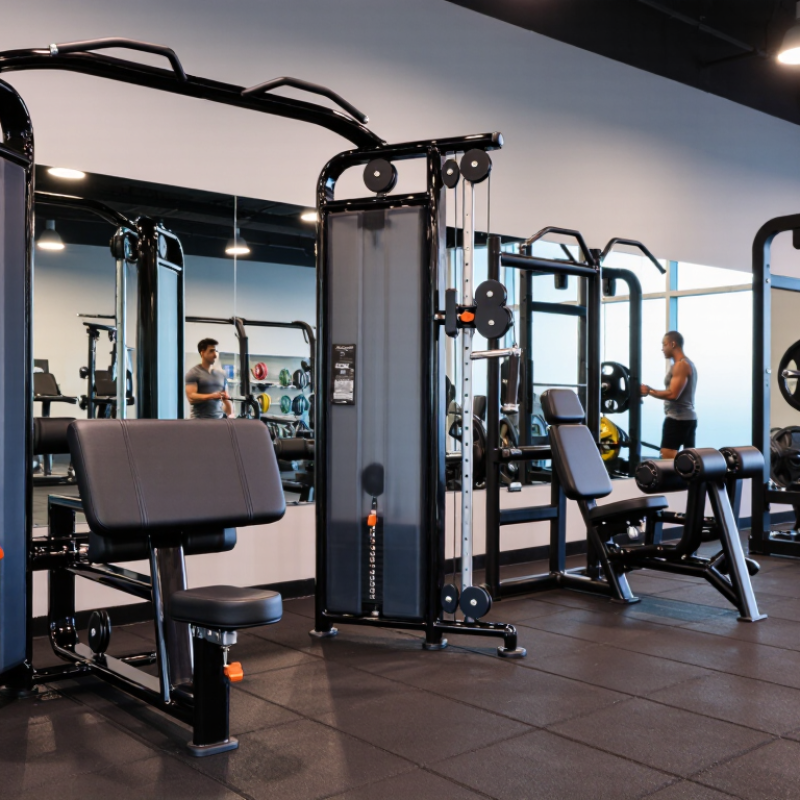
Before comparing machines, define what members will actually train. A facility serving beginners may need guided resistance machines, adjustable benches, and simple cable stations. A performance gym may require power racks, lifting platforms, and heavier storage systems. Ask coaches about peak class sizes, common exercises, and member skill levels. Write the answers down. That simple record prevents expensive equipment from matching the wrong audience.
Measure usable floor area, not just the room’s total dimensions. Include columns, doors, emergency pathways, storage, and staff workspaces. A strength machine needs operating clearance, not merely space for its frame. Leave clear routes around benches and racks. Check ceiling height before selecting tall pulley systems. Plan storage near the equipment it serves. Do not trust a rough sketch. Small measurement errors can make a busy room frustrating.
Match the equipment plan to training demand and traffic flow. Place high-use machines where coaches can supervise them easily. Keep free-weight areas separate from quieter resistance stations when possible. Review technical documents for dimensions, load ratings, anchoring requirements, and maintenance access. Ask a qualified installer to confirm floor loading and installation conditions. Noise matters, especially near reception or recovery spaces. A crowded room can reduce safety and user confidence, even when every machine is technically commercial grade. One layout may look efficient on paper but fail during a full evening session.
Commercial strength machines should be compared by use, function, and construction, not polished showroom appeal. The Health & Fitness Association’s 2024 U.S. Health & Fitness Consumer Report recorded 72.9 million facility users in 2023. That traffic level changes the buying question. Ask whether each machine can survive repeated use across different body sizes. ACSM’s 2025 Worldwide Survey ranked traditional strength training among the five leading fitness trends.
Selectorized machines offer controlled paths, quick weight changes, and simple coaching for beginners. Plate-loaded units often provide heavier loading and a familiar free-weight feel, but they demand careful spotting. Cable stations support rows, presses, rotations, and rehabilitation-style adjustments in limited floor space. Compare range of motion, seat adjustments, stack increments, and user access before comparing prices. Small details matter. A smooth pulley is not enough. Check whether guards, pins, and handles remain secure after repeated cycles.
For commercial-grade construction, inspect frame thickness, weld consistency, fasteners, bearings, cable coating, and upholstery density. Ask for rated loads, endurance-test methods, warranty exclusions, replacement-part timelines, and maintenance instructions. The Global Wellness Institute reported the physical activity economy at about 1.1 trillion dollars in 2023, signaling strong demand but not guaranteed equipment quality. A practical site test includes ten checkpoints: stability, noise, alignment, balance, adjustability, clearance, cleaning, service access, documentation, and comfort. I would not pretend every “commercial” label means the same thing. Some specifications remain vague. Record them before signing.
Buying commercial strength training machines requires more than comparing weight stacks and finishes. Safety, adjustability, and user access should guide every decision. The ACSM 2024 Worldwide Survey ranked traditional strength training among the leading fitness trends, increasing pressure on facilities to serve varied users safely.
Inspect frame stability, cable routing, locking pins, guards, and visible wear points. ISO 20957 emphasizes stability, mechanical safety, and clear operating instructions for stationary training equipment. A practical floor check should include a loaded test, not just a visual inspection. Listen for cable scraping. Check whether handles remain secure under uneven force. Small failures become expensive problems.
Adjustability must feel intuitive. Seat height, back support, range limiters, and grip positions should move smoothly without tools. Controls need clear labels and enough contrast for quick identification. The CDC’s National Center for Health Statistics reported that only about 28% of U.S. adults met both aerobic and muscle-strengthening guidelines in recent data. That gap includes beginners, older adults, and people returning after injury. Low step-in heights, wide access points, and stable transfer areas matter. The WHO’s 2022 global disability report estimates that 1.3 billion people experience significant disability. A machine that excludes them is not truly commercial-grade.
Test accessibility with real users, not assumptions. Ask someone with limited reach to adjust the seat. Watch whether a shorter user can see the pin. I have found that “easy to use” often means easy for the installer. That is an uncomfortable flaw worth correcting.
Buying commercial strength training machines requires more than comparing prices and polished specifications. Durability should be tested through frame construction, weld quality, cable routing, adjustment points, and protective finishes. A stable machine should remain quiet when loaded and should not wobble during repeated movements. Ask for the maximum user weight, tested load, and expected service life. Do not accept vague claims. Request inspection records or independent testing details when available.
Maintenance requirements can determine the real cost of ownership. Check whether cables, bearings, upholstery, and fasteners are easy to inspect and replace. Clear access saves staff time. It also reduces neglected repairs. Ask how often lubrication, bolt checks, and cable inspections are recommended. I once underestimated maintenance labor because the manual looked simple. That was a mistake. The machine needed more frequent checks in a busy training room.
Warranty coverage deserves careful reading. Confirm the coverage period for the frame, moving parts, upholstery, and labor. Some warranties exclude damage caused by intensive daily use, incorrect assembly, or poor maintenance. Clarify who pays for shipping and replacement components. Keep invoices, installation records, and service logs. They may protect a valid claim. A long warranty is not automatically reliable. Response times matter more when a machine is used by dozens of members each day. Ask for written support procedures, not promises made during a sales conversation. Some details may still remain unclear, so record every answer before purchasing.
| No. | Buying Tip | Durability Assessment | Maintenance Requirements | Warranty Coverage to Verify |
|---|---|---|---|---|
| 1 | Define the expected usage level | Estimate daily users, operating hours, training intensity, and whether the equipment will be used continuously in a busy facility. Select equipment rated for commercial use rather than occasional home use. | Create a routine inspection schedule based on usage volume. High-use equipment generally requires more frequent checks of fasteners, moving parts, cables, and upholstery. | Confirm that the warranty applies to commercial or institutional use. Some warranties differ significantly between residential and commercial applications. |
| 2 | Inspect the frame and weld quality | Look for a rigid steel frame, consistent welds, stable feet, protected joints, and minimal frame movement during operation. Ask for the frame material and load-testing information. | Keep frame surfaces clean and dry, tighten accessible hardware as specified, and inspect weld areas for cracks, deformation, or unusual movement. | Check whether the frame has separate long-term coverage and whether damage caused by improper installation, overloading, or modification is excluded. |
| 3 | Evaluate cables, pulleys, and bearings | Cables should move smoothly without fraying, kinking, or excessive slack. Pulleys and bearings should rotate quietly without grinding, binding, or excessive side-to-side play. | Inspect cable coating, end fittings, pulleys, bearings, and alignment regularly. Replace worn cables and damaged components immediately rather than continuing operation. | Determine whether cables, bearings, pulleys, and other wear components are covered, and identify any time limits or exclusions for normal wear. |
| 4 | Review weight-stack and adjustment mechanisms | Weight-stack guide rods should remain straight and stable, selector pins should engage securely, and adjustment points should operate without sticking or excessive looseness. | Clean and inspect guide rods, selector pins, adjustment handles, and locking mechanisms. Use only the lubricant and cleaning products recommended in the service documentation. | Verify coverage for guide rods, selector pins, adjustment hardware, and weight-stack components, including labor and replacement-part terms. |
| 5 | Check upholstery and contact surfaces | Assess upholstery thickness, stitching, edge protection, mounting hardware, and resistance to repeated use. Cushions should remain securely attached without excessive compression or movement. | Clean and disinfect surfaces with products compatible with vinyl or synthetic upholstery. Inspect seams, tears, exposed staples, and loose bolts during scheduled checks. | Ask whether upholstery, padding, stitching, and cosmetic finishes are covered separately from the main frame and mechanical components. |
| 6 | Confirm realistic user and load limits | Compare the stated user weight, resistance capacity, and adjustment range with the facility’s intended users. Do not rely on appearance alone when evaluating structural capacity. | Post operating limits where appropriate and train users not to exceed the specified capacity. Inspect equipment more often if it is routinely used near its maximum rating. | Confirm that warranty protection remains valid when the equipment is used at its published maximum capacity and in a commercial environment. |
| 7 | Examine stability, ergonomics, and safety features | Test the machine for rocking, unexpected movement, pinch points, sharp edges, and unstable adjustments. Handles, pads, stops, and locks should remain secure throughout the exercise motion. | Inspect safety locks, adjustment pins, end caps, grips, and protective guards. Remove equipment from service if a safety-critical component is damaged or fails to lock correctly. | Clarify coverage for safety mechanisms and determine whether installation, user instruction, or misuse exclusions could affect a claim. |
| 8 | Assess parts availability and service support | A durable machine is more useful over time when replacement cables, pulleys, upholstery, pins, bolts, and other service parts can be obtained without excessive delay. | Request preventive-maintenance instructions, service intervals, exploded diagrams, and access to qualified technicians. Keep a record of inspections and replaced parts. | Check who handles warranty repairs, expected response times, shipping responsibilities, and whether replacement parts remain available after the warranty period. |
| 9 | Verify installation and facility compatibility | Confirm floor loading, ceiling clearance, doorway dimensions, anchoring needs, ventilation, and equipment spacing before purchase. Correct installation helps prevent premature wear and instability. | Follow the installation manual, level the equipment, tighten all specified fasteners, and recheck hardware after the initial operating period. | Determine whether professional installation is required for warranty validity and whether relocation, incorrect anchoring, or unsuitable flooring can void coverage. |
| 10 | Compare the complete cost of ownership | Consider expected service life, replacement-part costs, downtime, energy or consumable needs, and the availability of technical support—not only the purchase price. | Build an annual maintenance budget covering inspections, cleaning supplies, lubrication where permitted, wear-part replacement, repairs, and staff training. | Read the full warranty terms for duration, parts and labor, commercial-use eligibility, exclusions, claim procedures, transportation costs, and any prorated coverage. |
Tip 1 Calculate the complete purchase cost, not just the machine’s price. Include freight, flooring, assembly, electrical work, taxes, staff training, and delivery delays. A commercial treadmill may need dedicated power and reinforced flooring. Measure twice. Mistakes become expensive after delivery.
Tip 2 Estimate five-year ownership costs. Add preventive maintenance, replacement cables, belts, batteries, software fees, cleaning supplies, and expected downtime. IHRSA’s 2024 Global Health and Fitness Association data shows strong member demand for facility-based training, but equipment availability still affects user satisfaction. One failed machine can create queues during peak hours. I once underestimated service visits. That was a useful, costly lesson.
Tip 3 Compare value through utilization, safety, and service access. Deloitte and EuropeActive reported 67.6 million fitness members and €31.8 billion in European fitness-market revenue for 2023. This growth increases pressure on operators to deliver reliable equipment. Ask for maintenance intervals, spare-part lead times, warranty exclusions, and technician coverage in writing. A lower-cost machine may lose value quickly if repairs require long shipping times.
Create a simple spreadsheet with purchase cost, installation, annual maintenance, energy use, and resale value. Divide the five-year total by expected monthly user sessions. This reveals the real cost per use. The calculation will not be perfect. Staff habits and seasonal demand can change it. Still, a transparent estimate is safer than trusting a showroom demonstration.
Cite: Deloitte and EuropeActive, European Health & Fitness Market Report 2024; IHRSA, Global Health and Fitness Association industry data.
Ask coaches about member skill levels, common exercises, and peak class sizes. Write the answers down. Beginners may need guided machines, adjustable benches, and simple cable stations. Performance users may need racks and lifting platforms.
Measure usable floor area, not only total room dimensions. Include columns, doors, storage, emergency paths, and staff workspaces. Check ceiling height. Allow operating clearance around machines, benches, and racks.
Place high-use machines where coaches can see them easily. Keep free-weight areas separate from quieter resistance stations when possible. Leave clear routes. A layout may look efficient on paper but fail during a crowded evening session.
Review frame construction, weld quality, cable routing, adjustment points, and protective finishes. A stable machine should stay quiet under load. It should not wobble during repeated movements. Request tested loads, user-weight limits, and service-life information.
Confirm whether cables, bearings, upholstery, and fasteners are easy to inspect and replace. Ask about lubrication, bolt checks, and cable inspections. Access saves time. Busy facilities may need more frequent checks than manuals suggest.
Check separate coverage for the frame, moving parts, upholstery, labor, and replacement components. Ask who pays shipping. Read exclusions carefully. Keep invoices, installation records, and service logs. Response time may matter more than a long coverage period.
Include freight, flooring, assembly, electrical work, taxes, staff training, and delivery delays. Some machines may require dedicated power or reinforced flooring. Measure twice. Installation mistakes become expensive after delivery.
Create a five-year spreadsheet covering maintenance, energy, replacement parts, software, downtime, and resale value. Divide the total by expected monthly user sessions. The estimate will be imperfect. Seasonal demand and staff habits can change the result. Still, it is safer than trusting a showroom demonstration.
Choosing the right Commercial Strength Training Machines requires more than comparing prices or appearances. Start by identifying your facility’s training goals, user population, and available floor space. Consider whether you need equipment for general strength, athletic performance, rehabilitation, or group training. Compare machine types, exercise functions, weight capacities, frame construction, and commercial-grade materials to ensure each unit suits frequent use.
Safety, adjustability, and accessibility should also guide your decision. Look for secure locking systems, smooth movement, clear instructions, adaptable seats and handles, and designs that accommodate users of different sizes and abilities. In addition, examine expected durability, cleaning needs, replacement parts, service support, and warranty coverage. Finally, calculate the complete investment, including delivery, installation, flooring, staff training, maintenance, and future upgrades. A machine with a higher initial cost may provide better long-term value if it offers reliable performance, lower downtime, and a longer service life. Careful planning helps create a safe, efficient, and sustainable training environment.