Engineered for high-volume commercial facilities, sports hubs, and OEM importers operating in Hamburg, Munich, Frankfurt, and Berlin.
As a specialized rubber matting manufacturer and B2B global exporter, our production methodology is meticulously tailored to meet the strict technical, environmental, and regulatory framework of the German market (DACH region). Importing elastomeric floor coverings into Germany requires adherence to rigorous national standards, including precise PAH/PAK chemical thresholds, stringent fire reaction behavior under DIN EN 13501-1, and proven acoustic isolation performance (Trittschalldämmung).
The German market demands zero compromise between physical durability and indoor environmental health. Rubber tiles and rolls installed in municipal fitness halls, private gym chains (such as those in Munich, Hamburg, Berlin, and Cologne), or industrial automotive assembly lines must satisfy both mechanical force dispersion requirements and indoor air quality protocols under the AgBB scheme.
Information Gain Insight: Unlike standard commercial SBR mats bonded with low-cost TDI adhesives that emit volatile organic compounds and pungent odors, our German-spec rubber matting uses 100% solvent-free MDI (Methylene Diphenyl Diisocyanate) polyurethane prepolymers combined with virgin EPDM or purified tire-derived SBR granulate. This ensures compliance with AfPS GS 2019:01 PAK Category 1 & 2 limits for skin-contact items.
Strict control over Polycyclic Aromatic Hydrocarbons. All products exported to Germany pass third-party lab testing for 15 restricted PAHs, ensuring safe prolonged skin contact in commercial environments.
Engineered shock absorption matrix designed to satisfy HIC (Head Injury Criterion) safety metrics. Ideal for cross-training zones, heavy weightlifting drop pads, and playground underlayments.
Micro-porous elastomer structure eliminates structure-borne noise transmission. Crucial for urban German multi-story commercial buildings requiring low Trittschall impact sound levels.
To assist German procurement managers, structural engineers, and fitness facility developers, the following matrix outlines our standard manufacturing tolerances versus official German industry benchmarks:
| Performance Parameter | Test Standard / Test Method | German Market Standard | Our Factory Specification |
|---|---|---|---|
| PAH / PAK Content | AfPS GS 2019:01 PAK (15 PAHs) | < 1.0 mg/kg (Cat 2 Skin Contact) | < 0.2 mg/kg (Passes Cat 1 & 2) |
| Fire Behavior | DIN EN 13501-1 / EN ISO 9239-1 | Cfl-s1 or Efl-s1 (Public Build) | Cfl-s1 Flame Retardant Option |
| Indoor VOC Emission | AgBB Scheme / ISO 16000 | 3-day & 28-day low VOC thresholds | Passed / Low-Odor MDI Polymer |
| Tensile Strength | DIN 53504 / ISO 37 | > 1.5 MPa (Standard SBR) | 3.8 MPa - 5.2 MPa (High Pressure) |
| Slip Resistance | DIN 51130 / DIN 51097 | R9 - R10 Commercial Rating | R10 Wet & Dry Non-Slip Surface |
| Abrasion Resistance | DIN ISO 4649 (Rotational Drum) | < 200 mm³ Volume Loss | < 120 mm³ (Heavy Industrial Grade) |
German commercial sectors utilize specialized elastomeric matting across a wide range of operational environments. Our OEM production lines offer customized thickness, density, and interlocking tooth geometry tailored to each distinct application:
Urban real estate in Germany frequently places commercial fitness facilities directly above office spaces or residential apartments. Heavy barbell drops generate low-frequency structural vibration that travels down concrete slabs. Our 30mm–50mm dual-layer puzzle rubber tiles feature a high-density top surface for wear resistance combined with a hollowed acoustic pedestal underside. This configuration dampens structure-borne shock, achieving up to 26 dB impact noise reduction.
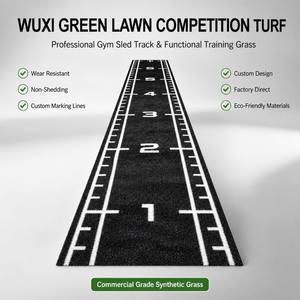
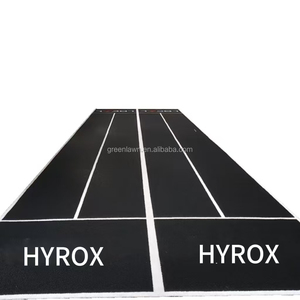
As the birthplace of HYROX, the German sports market requires heavy sled turf mats that withstand extreme lateral shear forces. Our synthetic turf sled tracks utilize a 100% polyethylene monofilament yarn tufted into a heavy-duty SBR/EPDM vulcanized backing. The rubber backing ensures the turf lies completely flat without buckling, bunching, or shifting when loaded sleds up to 250 kg are pushed repeatedly across the surface.
In Germany's manufacturing hubs across Baden-Württemberg and North Rhine-Westphalia, industrial ergonomic matting is essential for worker health in automotive, logistics, and electronics manufacturing. Our anti-fatigue bubble rubber mats provide elastomeric cushioning that reduces joint impact and lower back fatigue for operators standing at assembly lines for 8 to 12-hour shifts. Oil-resistant NBR (Nitrile) blends are available for machining environments exposed to cutting fluids and lubricants.
Germany maintains a sophisticated equestrian industry requiring non-porous, slip-resistant rubber flooring for stables, wash bays, and horse trailers. Our high-pressure vulcanized rubber stable mats are impervious to urine, stall disinfectants, and water, providing thermal insulation against cold concrete subfloors while reducing bedding material requirements by up to 70%.
The German market for rubber matting is undergoing a rapid transition toward sustainable materials and full supply chain transparency, driven by national legislation and changing buyer expectations:
1. Compliance with the German Circular Economy Act (Kreislaufwirtschaftsgesetz - KrWG): German procurement authorities favor suppliers who utilize recycled secondary raw materials without compromising physical performance. Our factory utilizes high-purity recycled SBR derived from end-of-life European truck tires, diverted from landfills and processed through magnetic metal separation and dust extraction systems.
2. AgBB & French VOC A+ Indoor Air Safety: German architects and general contractors demand low-VOC building materials. The traditional odor associated with cheap rubber tiles is completely unacceptable in modern German interior fit-outs. By switching from sulfur-vulcanized low-grade rubber to cold-cured MDI polyurethane binding, our rubber mats achieve zero toxic off-gassing, complying with AgBB testing standards for indoor public buildings.
3. Precision Interlocking Click Systems: High installation labor costs in Western Europe have driven demand for puzzle tiles with CNC die-cut precision interlocks. Our interlocking rubber mats can be installed without full-surface adhesive bonding, significantly reducing setup time, eliminating glue emissions, and allowing modular replacement or facility relocation.
Partnering directly with our factory provides German importers, fitness distributors, and industrial suppliers with distinct competitive advantages over typical trading companies:
In-house CNC mold-making allows custom logo water-jet cutting, custom color EPDM fleck ratios (10% to 50%), custom thickness profiles, and private label packaging for German brand owners.
Every batch undergoes automated durometer testing, density checks, tensile elongation testing, and dimensional tolerance checks (+/- 0.5mm) prior to container loading.
FCL container loading (20ft / 40ft HQ) on export-grade fumigated wooden pallets with plastic shrink wrap and edge protection. Direct shipping routes to Hamburg, Bremerhaven, and Rotterdam.
Factory Direct Promise: We sell exclusively through our dedicated export division and authorized distributor network. Every shipment includes full commercial invoices, packing lists, certificate of origin (Form A / EUR.1), technical data sheets (TDS), and REACH compliance declarations.
Addressing key technical, regulatory, and logistics queries regarding rubber matting exports to Germany.
Request technical data sheets, laboratory test reports (PAH/PAK, DIN EN 1177, Fire Cfl-s1), sample swatches, or direct container factory quotations today.
Inquire Now